
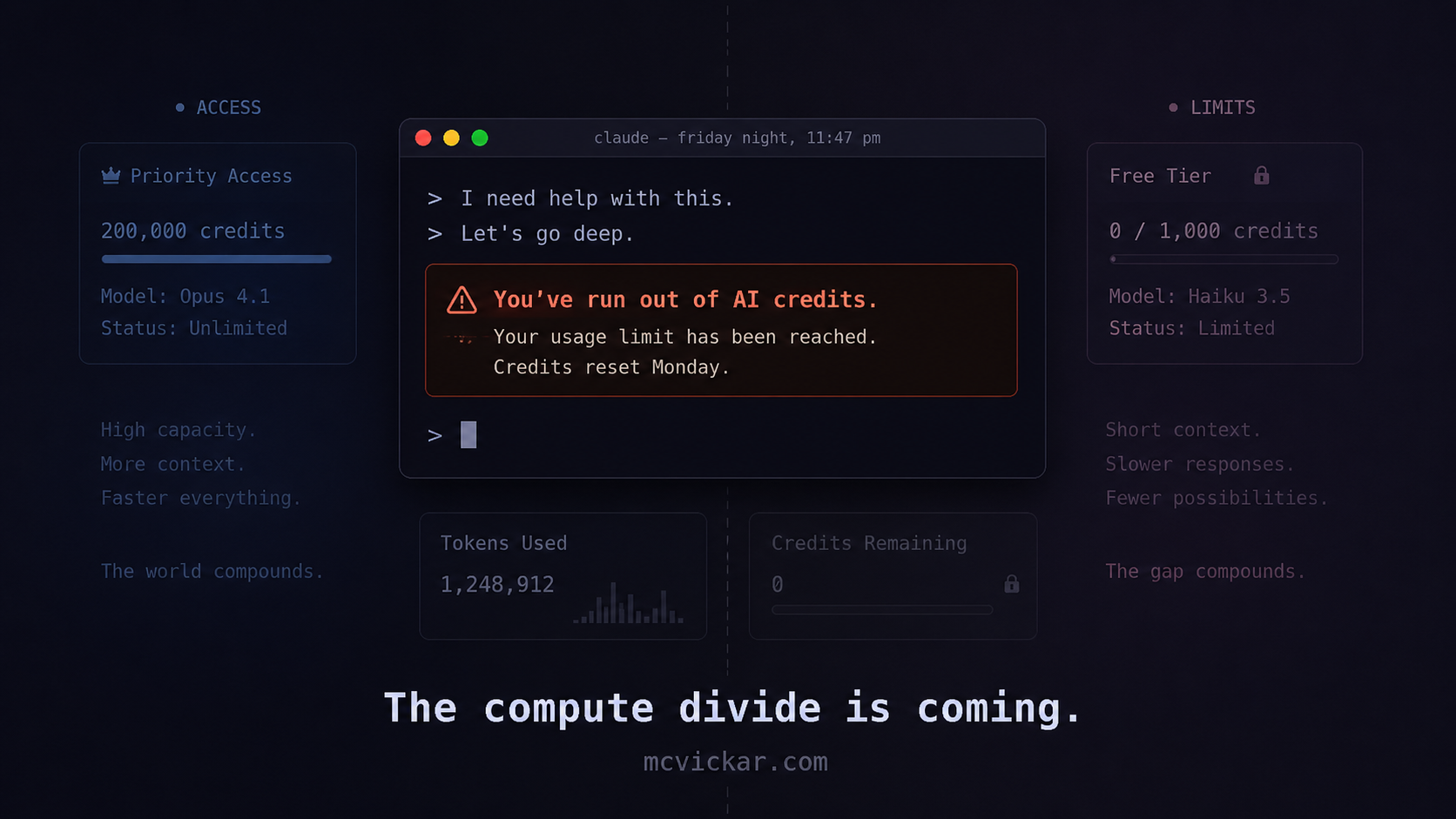
It was a Friday night and I was on a roll. And I don’t mean idle tinkering. I’ve been doing some writing, some journaling, and a handful of personal experiments — really just exploring how far Claude and Claude Code can go. Friday night, multiple sessions humming. And then, mid-thought, mid-sentence, mid-*everything*:
**“You’ve reached your usage limit.”**
Resets Monday.
Monday.
I stared at that message the way you stare at a gas gauge on empty, forty miles from the nearest station. I refreshed the page, as if maybe the limit was a misunderstanding between friends. It was not. I had spent my credits, and the machine — very politely — cut me off.
And here’s the detail that matters: I’m not on the free tier. I pay $100 a month for this. I’m a paying customer with a real plan, real projects, and real momentum — and I still drained the tank.
## The Two Versions of Me
Here’s the part that makes it funny, or at least ironic. At work, I use Claude every day, and I’ve never once hit a ceiling. I don’t know if the budget is unlimited, but I haven’t found the edge of it yet. Nine to five, I’m a man of means. Compute flows like water.
Then I go home, log into my personal account, and suddenly I’m on rations. Same person. Same brain. Same momentum. But now every session is a withdrawal from a finite account, and some weekends the account runs dry.
That Friday night, I did what any reasonable adult would do: I checked the reset timer roughly every four hours, like it was a pizza tracker. And then I did the other thing. The thing I want to be honest about, because it’s the whole point of this post.
I pulled out my credit card and bought more credits.
One hundred dollars a month wasn’t enough, so I topped off. And standing there, card in hand, mid-transaction, I heard a voice in the back of my head that sounded a lot like every casino floor and every “0% APR for the first six months” offer I’ve ever walked past:
*Just a little more. You’re so close. Don’t stop now.*
That’s when the thought landed: this is going to be the next thing we can’t put down.
## We’ve Seen This Movie Before
I laughed when I thought it, but I haven’t been able to shake it since.
I remember being in college when the credit card companies set up folding tables outside the bookstore, handing out free t-shirts for filling out an application. I remember how easy it was to rack up a balance a little at a time — never one big decision, just a hundred small ones that each felt reasonable in the moment. It took some of us years to dig out. Nobody at those tables ever mentioned that part.
Now picture that same dynamic, except the thing you’re buying isn’t pizza and spring break. It’s *capability*. It’s the tool that makes you faster, smarter, more productive — the one that helps you finish whatever you started. “Just top off the credits” is a much easier sell than a cash advance ever was, because it doesn’t feel like consumption. It feels like investment. Right up until the statement comes.
I’ve also written before about wrestling with Apple Screen Time as a parent — trying to meter out my kids’ access to the thing they wanted most, watching them negotiate, plead, and probe the system for loopholes. The irony isn’t lost on me. Now Anthropic is the parent, I’m the teenager, and I spent a weekend negotiating with a reset timer.
And here’s the thing: the black market I joked about? It already exists. There are gray-market resellers pooling AI subscriptions and offering access at a fraction of official rates. Power users are running multiple accounts and rotating between them like a shell game. Venture folks are writing essays arguing that tokens are the new scarce resource, and that rationing isn’t a bug in these systems — it’s the business model. The bartering, the trading, the workarounds — none of that is a prediction anymore. It’s a Tuesday.
## The Real Point Under the Joke
Because underneath the humor, something real is happening.
Once you’ve worked *with* AI — really worked with it, built with it, thought with it — going without doesn’t feel like losing a tool. It feels like losing a capability. Like your workshop burned down but only on weekends. That’s a new kind of dependence, and we’re all signing up for it voluntarily, one subscription at a time.
And scarcity always creates the same things: haves and have-nots, gray markets, rationing, and people making hard choices about what they can afford. I’m fortunate — I have a good handle on it, my projects are real, and a $100 subscription plus the occasional top-off is a line item I can absorb. But I keep thinking about a 20-year-old version of me, the one who signed up for a credit card to get a t-shirt. What does he do when the credits run out at 2 a.m. and the project is *almost* working? He tops off. And tops off again. We’re heading toward a world where access to compute shapes who gets to build, learn, create, and compete — and where the people least able to afford it will feel the most pressure to keep paying. We spent twenty years talking about the digital divide. The compute divide is going to make that one look quaint.
So yes — I made it to Monday. The plan reset, the top-off credits carried me through, the projects resumed, and all was forgiven.
But I’ve started budgeting my sessions now. Planning my prompts before I spend them. Saving the good credits for the work that matters. Watching the meter.
If that sounds less like using a product and more like managing a habit — well. That’s kind of the point.
*What about you — have you hit the wall yet? And be honest: did you wait it out, or did you reach for the credit card?*






+ There are no comments
Add yours